How to Get the Most Out of a Small Reach-In Closet
Small reach-in closet organization ideas: double hanging, shelving towers, drawers, and the design moves that double your usable space.
Reach-in closets get a bad rap. People walk into a master bedroom with a 5-foot-wide closet, sigh, and assume there's nothing to be done. Small closet equals clutter, end of story.
Not true. You can absolutely organize a small reach-in and get more out of it than you ever thought possible. You just have to design it right, because most reach-ins as they come from the builder are wasting half their space.
Here's how to actually fix that.
What's Wrong with the Standard Reach-In?
Most reach-in closets, especially in homes built before 2000, have one setup: a single rod at about 66 inches off the floor, with a shelf above it. That's it.
Here's why that's bad.
The rod is too low. You're losing a foot and a half of vertical space underneath it, because clothes on hangers don't hang down that far. Shirts take about 36 inches. Pants folded over a hanger take about 32 inches. You could fit another hanging section below.
The shelf is too shallow. One 12-inch-deep shelf above the rod isn't enough. You could have three shelves in that space, giving you room for seasonal bins, handbags, and things you actually want stored above.
There's nothing on the floor. Shoes just pile up. Nothing is holding them. They migrate all over the closet.
There are no drawers. Everything that isn't on a hanger or a shelf ends up in the bedroom dresser, which adds clutter to the bedroom.
A standard reach-in wastes roughly 40% of its cubic volume. That's the problem we're solving.
Design Move #1: Double Hanging
The biggest win in a small closet is almost always double hanging.
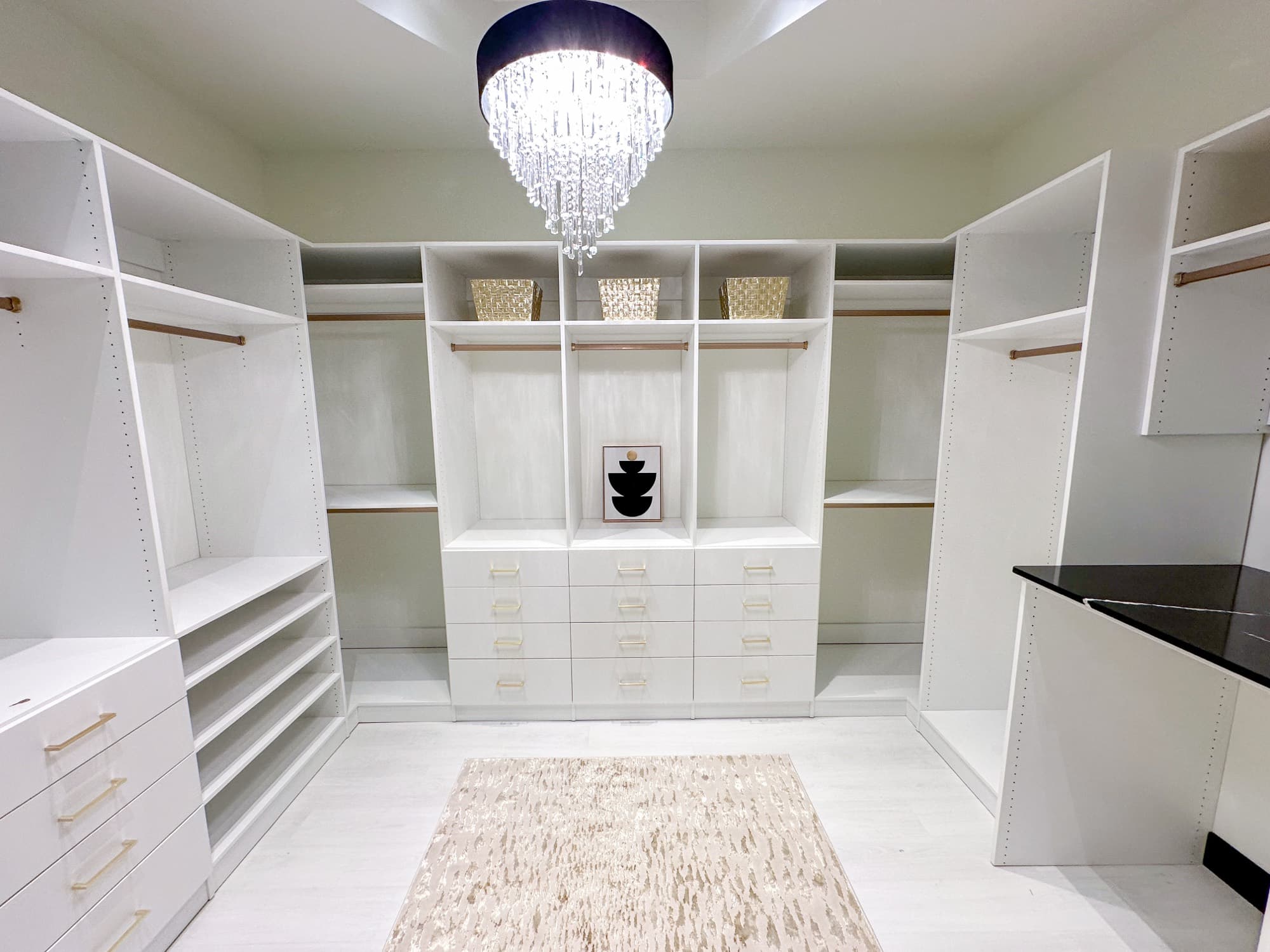
You take out the single rod at 66 inches. You put one rod at 82 inches and another rod at 42 inches. Now you've got two levels of hanging in the same footprint. Shirts on top, pants on the bottom. Or shirts on top and folded items on a shelf below. Or one side double-hang, the other side tall for dresses.
This single change can double the hanging capacity of a small reach-in. It's the first thing we do on almost every reach-in project.
The one catch: long items (dresses, long coats, some pants) need a tall section. We usually leave one section of the closet as a single tall rod, and the rest becomes double. That way you get both.
Design Move #2: Shelving Tower or Drawer Column
If you've got a wider reach-in (6 feet plus), you can dedicate the middle or one end to a tower.
A shelving tower is 12 to 16 inches wide, runs floor to ceiling, and holds 8 to 12 adjustable shelves. This is where your folded items live. Jeans, sweaters, workout clothes, t-shirts. All visible, all reachable.
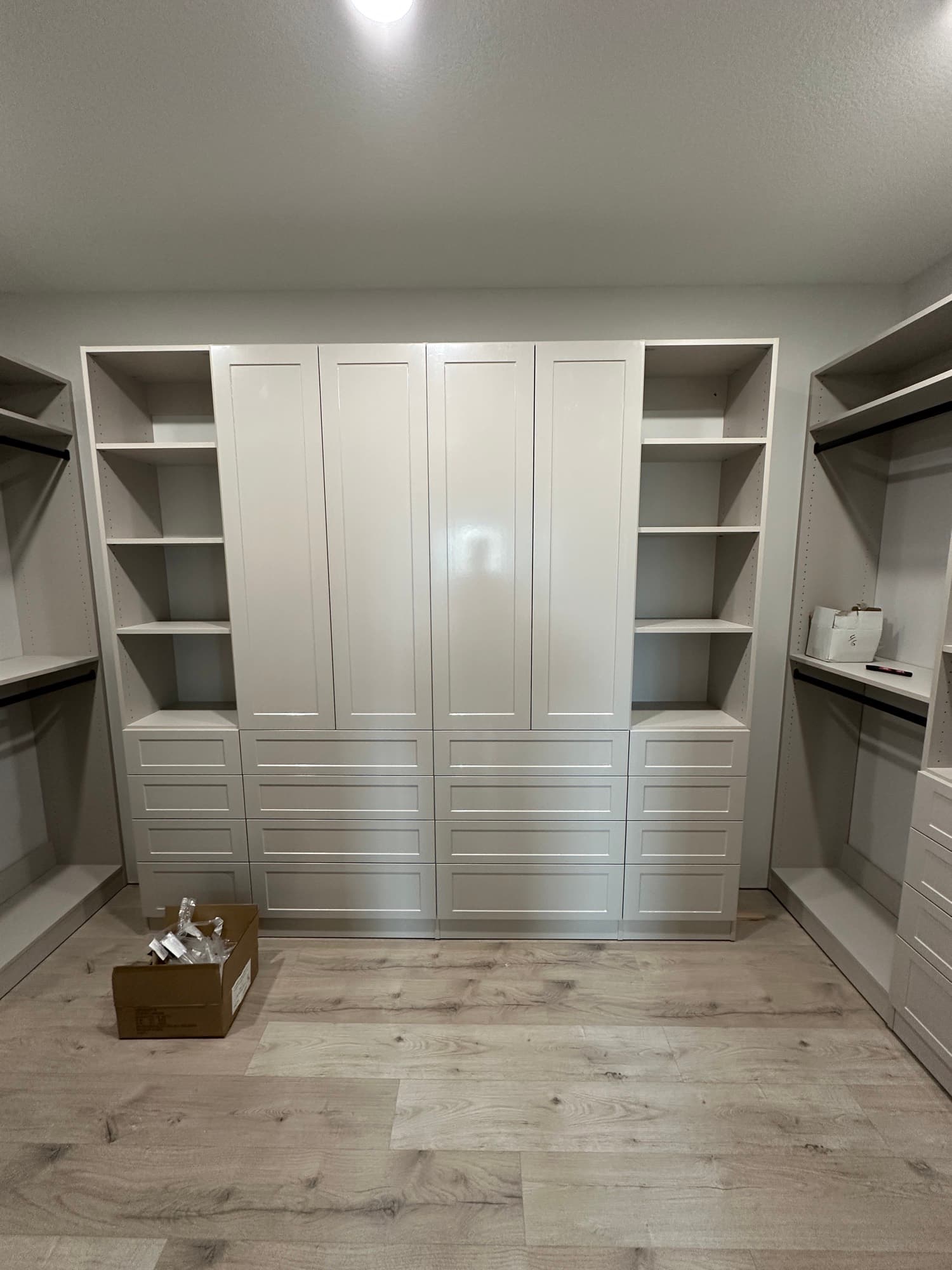
A drawer column is the same footprint but with 4 to 6 drawers instead of shelves. This replaces your dresser entirely. If you move your bedroom dresser contents into the closet, the bedroom gets a lot bigger visually.
Either way, you're using vertical space that a standard closet completely wastes.
Design Move #3: Top Shelf Done Right
The shelf above the hanging sections is prime real estate for seasonal storage. Bins, suitcases, duvet covers, stuff you use twice a year.
The standard builder shelf is 12 inches deep. That's not enough. We install shelves 14 to 16 inches deep, sometimes with a second shelf above that, giving you two usable shelves in the 18 inches of vertical space above your hanging rod.
This is where the stuff that currently lives in the garage or under the bed goes. And you can still reach it, because a reach-in by definition isn't deep enough to make that shelf dangerous.
Design Move #4: Shoes Off the Floor
Shoes pile up. Always. If you don't give them a home, they're a disaster.
Options:
- Angled shoe shelves. Built into the bottom of the tower. Great for up to 12 pairs.
- Flat shelves with dividers. Hold more pairs but harder to see at a glance.
- Pull-out shoe racks. Premium, but super clean looking.
- Over-the-door organizer. Cheap and works, but not custom closet material.
For most reach-ins, a few angled shoe shelves at the bottom of the tower is the move. You get 8 to 12 pairs visible, organized, and off the floor.
Design Move #5: Hooks and Accessories
Small closets punch above their weight when you use hooks for things that would otherwise take up hanger space.
- Belt rack (10 belts in the space of one hanger).
- Tie rack (20 ties in the space of two hangers).
- Bag hooks (purses that would otherwise fight for floor space).
- Valet rod (a pull-out bar for tomorrow's outfit).
None of these are essential. All of them help.
Should You DIY or Go Custom?
Here's the honest answer.
DIY a small reach-in if:
- Your closet is a perfect rectangle with no obstructions.
- You're handy and have the right tools.
- You're willing to live with off-the-shelf component sizing.
- Your budget is tight.
A decent DIY reach-in in a standard rectangular closet runs $200 to $600 in materials from a home improvement store, plus your weekend. It'll work.
Go custom if:
- Your closet has any weirdness (angled wall, outlet in the middle, soffit at the top).
- You want it to actually look finished, not cobbled together.
- You want drawers, not just shelves.
- You've tried DIY before and ended up with a closet that's worse than where you started.
A custom reach-in from LB Classic Closets runs $1,000 to $3,500 fully installed. The low end gets you solid shelving, double hanging, and a shoe rack. The high end gets you drawers, premium finishes, and lighting.
What We Actually See Work
After decades of designing reach-ins across mid-Missouri, here's what we see work in a typical 5 to 6 foot wide reach-in:
- One tall hanging section on the left (for dresses, long coats).
- Double hanging in the middle (shirts top, pants bottom).
- A shelving tower on the right with 5 adjustable shelves and 3 shoe shelves at the bottom.
- Two shelves above the hanging sections for seasonal storage.
- A belt/tie hook rack on the inside of the door.
That configuration usually comes in around $1,200 to $1,800 installed, depending on finishes. It turns a chaotic closet into one you actually enjoy using.
Ready to Rethink Your Reach-In?
If you're tired of fighting your closet every morning, we can help. Our virtual consultations are free, and we can give you a real design and a real price based on photos and measurements you send in. No in-home visit, no pressure.
Small closets don't have to be a problem. They just need a better plan.
Thinking about a custom closet?
LB Classic Closets has been designing and installing custom closets across Mid-Missouri since 1987. Start with a free virtual consultation, no sales visit, no pressure.
Book a free consultation